

Palm Sunday – April 9th/10th, 2022 Lk 19:28-40, Is 50:4-7, Ps 22:8-9, 17-18, 19-20, 23-24, Phil 2:6-11, Lk 22:14—23:56 or Lk 23:1-49
It’s interesting to note that today, for Palm Sunday, the Roman Missal, the book that guides the celebration of the Mass and gives all the rubrics for celebrations, instructs the priest: “After the narrative of the Passion, a brief homily should take place, if appropriate. A period of silence may also be observed.”
It should call our attention that, for a Sunday Mass, one that is almost always very well-attended, the Church directly tells the priest that it’s ok for him not to say anything at all, that it’s ok for there just to be silence after we hear the Passion. It’s as though the readings speak for themselves, or that, in His suffering and death, Christ told us everything that really needs to be said about God, His love for us, and our dignity. In a sense, after the Passion, there’s nothing left to be said.
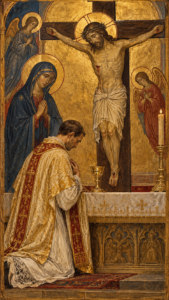
In the Church’s instructions we can see clearly the point of our Palm Sunday celebration. In a few days, we will re-live the Lord’s passion, death, and Resurrection. It is truly the center of, not only our liturgical year, but also of our lives, our world, and human history. Palm Sunday points us to the Cross, and reminds us that we can’t live this week like the crowds did. On this day, they greeted Jesus with applause and joy, but those same people would be clamoring for His death just a few short days later.
We must live our lives as a constant and continual following of Christ. In this week, we must try to really draw near to Christ, to take up our crosses, and follow Him. That option for silence is really the Church’s way of shouting to us that we need to turn to Christ, to seek Him, and only Him. Holy Week is the time to turn to God all the more fervently, and so today, through the intercession of Mary, Our Lady of Sorrows, let us ask for the grace to truly live out this Holy Week as a time to draw near to Christ and embrace our crosses.