
Monday of the Seventeenth Week in Ordinary Time – Odd Years – Mt 13:31-35
Today’s first reading and Gospel show us the consequences of the little things in our lives. The idolatry that the Israelites fall into doesn’t start as idolatry. They tell Aaron, “Come, make us a god who will go before us; as for that man Moses who brought us out of the land of Egypt, we do not know what has happened to him.” On one hand, it seems like they are impatient, since they want to get moving. On the other hand, there is a forgetfulness of the good deeds that God has wrought through Moses, and the desire simply to have something to believe in. Impatience and a lack of gratitude aren’t the most grievous of sins, but they can be a gateway for much more serious ones. In the Gospel, though, we see that even though our faith might start off small, it can grow and produce great effects. A mustard seed and yeast don’t seem like much but, when looked after, cared for, and used properly, have great consequences.
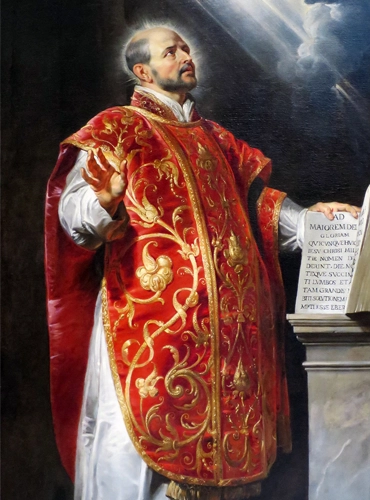
This should encourage us to work to uproot the little things in our lives that keep us from following God, and to encourage the little things, the little ways we serve Him, since these little things can become quite big. This was the experience of Saint Ignatius of Loyola. In the Loyola family castle, visitors can see the room where Ignatius lay when he was sick. It’s fairly plain, and doesn’t look like much. There is an inscription there that reads simply, Aquí se entrego á Dios Iñigo de Loyola; here Ignatius of Loyola surrendered himself to God.[1] Here Ignatius of Loyola surrendered himself to God, with all that that implies: his attachments, his desires, his wants, all to be at the service of the only King worth serving. It was something simple that brought him there, and the beginning didn’t seem like much, but from that moment in that room, we have a great saint from whose religious family we have many other saints. Today, through the intercession of Our Lady, let us ask for the grace to surrender our lives to God and to be faithful in the little things, so as to be faithful in the big ones too.
[1] Cf. Fr. James Martin, SJ, My Life with the Saints, 100.