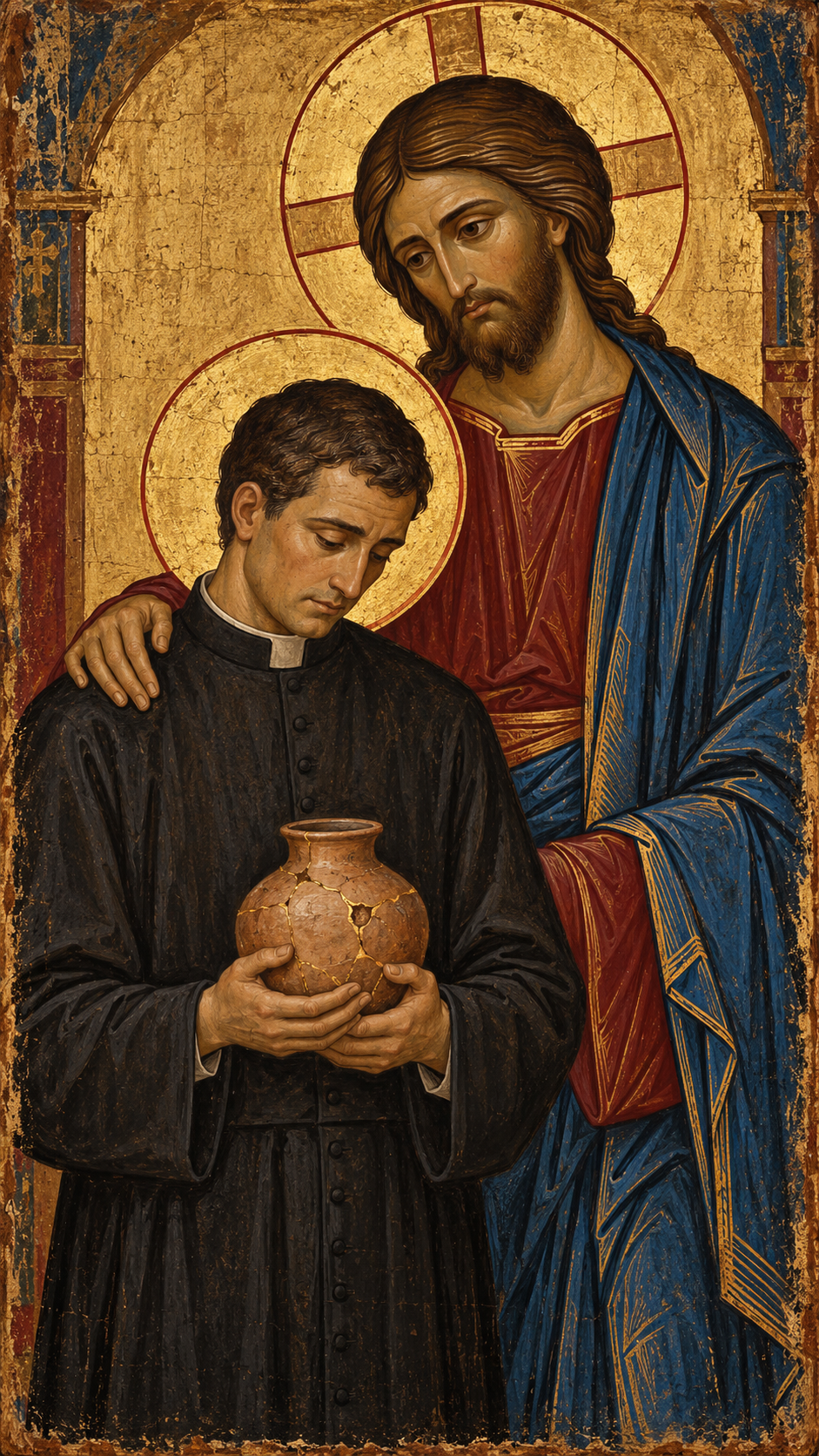

Now I want to speak from the bottom of my heart.
Among the many other things that are in crisis now-a-days, there is also a crisis in the Catholic priesthood. There are many causes: there are endogenic causes, that is, from within, and there are exogenic causes, or those from without. It is not just a thing of the present, something that began in our time, but it is, rather, a crisis that goes back centuries, because Satan has been trying to destroy Christian order for centuries; centuries ago, the one who Sacred Scripture calls the Ruler of this world (Jn 12:31; 14:30; 16:11) began and today continues looking–and continues finding, as can be seen more and more–for more supporters and more followers. One of the obstacles for Satan’s advance in the world is the Catholic priesthood, the Catholic priesthood such as it was created, thought up, and founded by our Lord Jesus Christ. It can be seen even now that there are Catholic priests in crisis; we can see this, for instance, when we make a trip for First Masses through different places (the trip with the newly ordained priests who celebrate their First Masses in their hometowns).
What is it that the devil tries to jeopardize in the Catholic priest?
In the first place, what Satan aims for, and what he will later try to achieve–not upon the first attack, but later on–is to put that supernatural faith in jeopardy. He goes looking, in different ways– we won’t examine these ways now–to have the Catholic priest stop making the supernatural act of faith, so that he loses sight of that supernatural dimension in his life. This means that later on, this loss will continue into his thoughts. Unfortunately, this is seen in many ways today; for example, there are the so-called “dissenting theologians.” What supernatural faith do these men have when they have no qualms about contradicting the one whom Jesus Christ Himself placed as “the Rock” of His Church, when they have no qualms about collecting signatures–as if the Church were a political party–in order to criticize the naming of bishops, or the Encyclical Evangelium Vitae, or Veritatis Splendor? What supernatural vision does a priest have when he converts the Holy Sacrifice of the Mass into a sort of show where he has the leading role, when really the lead actors of the Holy Mass are the Father, to whom the sacrifice is directed, the Son–who is the Victim and, at the same time, principal Priest–and the Holy Spirit? When a priest loses sight of the supernatural, when his conversations are worldly, when his only concerns are the problems of this world, the priest has given in to the world and has stopped being what Jesus Christ wants him to be. The priest must bring men to God, and if he doesn’t do this, he isn’t good for anything; he is sterile, he is the salt that has lost its flavor and only serves to be trampled underfoot by men. 1 Indeed, this is what happens to priests who have lost their faith: they are trampled underfoot by men!
The Ruler of this world seeks the ruin of the priest, and he seeks it in a special way, because the priest is the devil’s boccato di cardinale (choice morsel); the devil knows that if he can ruin the priest, his fall will obtain many other souls for hell.
Satan doesn’t look just for the priest to lose sight of the supernatural dimension, the dimension that belongs properly to faith, that of things not seen.2 He also seeks, and many times meets with success, to have the priest lose that properly human dimension of being rational: he wants the priest to act stupidly. The devil tries to do this above all by means of the modern philosophies of current thinkers whom the vast majority of people don’t know, but have sometimes read, at least in part; they are diffused by the mass media: people watch television, they see this program, this other one, and then a series of false ideas, sophisms, and attacks against the real metaphysics of being remain doing loops in their heads.
If the priest loses his reason, if he loses that which distinguishes man, if he loses that precious instrument that God wanted to give us and by which we are His image and likeness (Gn 1:26), then the priest is converted into a slave of what is said. For example, now-a-days it’s said, “Well, now there’s no reason to use a chasuble when celebrating Mass”; it is also said, “Why wash the hands–the rite of washing–when the priest asks God to pardon his sins? Well, let Him clean them! But, why that gesture of washing hands in front of so many people?” So, many things are said without any meaning.
So, little by little, that which God gave to our human nature so that man might be man, in order that man might be a rational being and so act in a rational way, is taken away from the priest. This is why God gave man intelligence, so that he might discover error and refute it, as an authentic priest must do.
The priest must give his life for others, but how can he give his life for others if he is incapable of defending the faith of others? How can he give his life for others if the priest is not capable of giving reasons for his faith, because he has let the sophisms of modern culture fill his head?
Furthermore, the devil hopes not only for the priest to set faith aside and to set reason aside, but, even more, he aims for the priest to act as though he were a nut in a piece of machinery, that is, even what we could call the priestly sensibility is attacked. What I am saying will sound strange to some, but this is something that has happened in these last centuries. I give three examples:
Martin Luther was a Catholic priest, and a religious–an Augustinian monk; he was the first to raise the standard against the supernatural order by breaking the primacy of the Pope–at least over him and over those who followed him–and establishing the principle of free examination, that is, that each person could interpret Sacred Scripture as it seemed to them, a piacere. How many followed him, including bishops of that era! It was what was fashionable, and they followed the fashions!
Later, when the era of the French Revolution came about, the era of liberalism in which men rose up against reason–even though they had raised an altar to the Goddess of Reason and, in the name of the Goddess of Reason they put the guillotine into action–how many priests were accomplices, altar boys of the Antichrist, while their brother priests, for example, in La Vandeé, died as martyrs, giving their lives rather than abandoning, before disowning Jesus Christ?
This is present even in our times, or perhaps we have already forgotten the Marxist priests, the guerrilla priests? This is what was fashionable: Marxism! Moving forward! It seemed to be the future of humanity, the whole world is going there and they, like idiots, rose up under the banner of Marx and Lenin, under Stalin and Kruschev!
How is this possible? Why was there this surrender of some of our brothers in the priesthood? One of the possible reasons is that the priest, like all human beings, is in the world and, as such, is exposed to its seduction. However, the priest must not lose sight of the fact that, like all the baptized, he must be in this world, he must participate in the present reality; he cannot be a person who lives on another planet. He has to be in this world, but he must not be of this world, just like all the other baptized! Yes! He must be in this world, but not of this world. This is what Jesus taught: They are in the world . . . [but] they do not belong to the world (Jn 17:11, 16). Accordingly, they must be in the world, but not of the world. The Pope indirectly indicated this separation from the world when he specifies what a priest is and what he is not: “You are priests and religious: you are not social directors, political leaders, or functionaries of a temporal power.”3 Some err because, not only are they in the world, but they are also, unfortunately, of the world as well, and this being of the world implies adopting its ideologies, which unavoidably leads to defection from the priesthood. Perhaps many adopt–on the theoretical level as well as in praxis–secular currents of thought, guided by the good intention of attracting modern man to the Church; the way to reach modern man, however, “is not by ceding to the suggestions of an easy, expressed secularization, or in the abandonment of ecclesial dress, by assimilating worldly customs, or by taking a secular office; that is not the path to draw near to the man of today.”4 The reality of the assimilation of secular thought is not something innocuous; on the contrary, it brings as a consequence the exclusion, by opposition, of the metaphysical and theological thought proper to and characteristic of the Catholic Church. Such an assimilation brings the loss of priestly identity, a loss of the sense of his transcendental function, and a rash adoption of worldly behavior that, in the first moments, might appear as an approach to contemporary culture, but that is quickly revealed for what it really is: the dissolution of the mystery of the priesthood into something worldly. This assimilation is the opposite of inculturation, and is useless. “This assimilation will perhaps give the impression, at first glance, of an ease of contact; but, what would it be worth if it must be paid for with the loss of the specific tasks of evangelization and sanctification that make the priest the salt of the earth and the light of the world? For what use is a priest who, assimilated to the world in such a way, becomes a disguised version of himself and not a fervent transformer?”5
Thus, in the era of Protestantism, of that poorly-named Reform, there were many priests and bishops who wanted to be a la page (in style), and because they bought into the error of the moment, they ended up abandoning Christ. So, too, did some later on become accomplices of liberal philosophy, and they ended up abandoning Christ. The same is true even now as, for some years, others have become Marxists, (although, on account of the implosion of communism, now materialism and living only for sensual pleasures remain, without the virulence that it had for some years), and these too ended up abandoning Christ.
This last attack, that of Marxism, was an attack that tried to have the priest concern himself only with the things of the world, the social things, the political, even the economic. This imbuing of an ideology provoked a disaster, and that is the reason why there is still the figure of the priest who occupies himself only with temporal things; there are even parishioners who push the priest to be busied only with worldly things. Nevertheless, the eminently supernatural character of the priesthood is such that the priest should be principally occupied with supernatural things,6 and only indirectly with temporal ones. His greatest preoccupation should be to bring souls to “full and active participation in the Eucharistic Sacrifice.”7 On the temporal level, he should work only as a spiritual director, forming consciences; it pertains to the priest “to serve truth and justice in the dimensions of human temporality but always in a perspective . . . of eternal salvation.”8 He should deal only indirectly with temporal things, because that field does not pertain to him; this field belongs by right, that is, directly, only to the faithful Christian laity.9
Now-a-days, in this last field, in the temporal field, in my way of thinking, there is a situation that implies a risk for the priest, and it is this: he must have great prudence in dealing with women. Now-a-days–even here in Argentina, but in other places even more–many women have caught stupid pox,10 and, when the pox went away, they were left stupid with the notion of feminism, on account of which they want to put themselves on the level of absolute equality with man (in the background there is a chauvinist vision that does not realize that the dignity of man and of women is equal, in such a way that each one has a different, but complementary, role).
“But, Father,” they will tell me, “we women are not evil!” Certainly you are not. It is just as certain that we–as we have been taught–have to look at a woman as we look at our mother, as we see our sister, as we see the Blessed Virgin. Yes, certainly, but there is a need to be prudent when opportunely cutting off relationships that become too familiar. However, it must also be known that not all women are good; there are many bad women who seek out the priest so that he might be lost. A priest once found himself in a bar around Flores with a former classmate of his from the seminary who had abandoned the priesthood, and he told the priest: “Look, all that I can tell you is: go and tell the Cardinal that there are women here, paid by the Masons, who are going to seek out priests, even in the confessional.” It must be kept in mind that sometimes the most dangerous ones are those who make themselves appear good.
We priests are flowers of a greenhouse, of an exquisite sensibility on account of our office and, as such, very fragile! We must know how to care for ourselves and to be very prudent!
The priesthood is something very serious; it’s not for playing tag,11 it’s not making oneself the nice guy, or the funny guy who makes us laugh, because, well, that’s not the work of the priest! The work of the priest is to take souls to God, and, as there are powerful enemies who try to impede this, we must support all priests with our prayers, sacrifices, penances, and true friendships, whoever those priests might be. Is he a priest, is he a minister of Jesus Christ? Then we must pray for him, do penance for him, help him, and offer him our sincere friendship. These times are certainly not easy ones to live in. Probably things will worsen, as we can sort of see. However, Jesus Christ does not lose power; He is the same yesterday, today, and forever (Heb 13:8). The Holy Spirit continues working, and He continues working marvels. We don’t need to be afraid, but we do need to be prudent and know that as priests we are on the frontlines of a difficult combat; it’s not to blow glass and make bottles, it’s not soap with a nice fragrance. It’s a fight, it’s a war; it’s a war of ideas, and in that war we must have the fortitude that comes from the Holy Spirit and that is a gift of the Spirit Himself.
Accordingly, commit yourself today to always pray for priests! Pray for those who are our shepherds! The true shepherd goes in front of the sheep so that the sheep don’t get lost and so that the sheep find the good pastures of true doctrine. We should ask for the grace for them to be authentic shepherds, that they might be prepared in their hearts to give their lives for the sheep.
Notes
- Cfr. Mt 5:13. ↩
- Cfr. Heb 11:1. ↩
- John Paul II, “Discourse to Priests and Religious in the Basilica of Our Lady of Guadalupe,” L’Osservatore Romano 6 (1979) 64. ↩
- John Paul II, “Discourse to a group of priests from Bologna,” March 19, 1979 ↩
- John Paul II, ibidem. ↩
- Cfr. Ecumenical Second Vatican Council, Dogmatic Constitution on the Church, Lumen Gentium, 28. ↩
- John Paul II, Homily for Holy Mass for American Priests, Philadelphia, L’Osservatore Romano 42, (1979) 528. ↩
- John Paul II, Letter Novo Incipiente (Holy Thursday Letter to Priests, 1979), 7. ↩
- Cfr. Ecumenical Second Vatican Council, Dogmatic Constitution on the Church, Lumen Gentium, 31; Ecumenical Second Vatican Council, Decree on the Apostolate of the Laity, 7: “Led by the light of the Gospel . . . they must act directly and in a definite way in the temporal sphere, as . . . the temporal order must be renewed.” ↩
- Viruela boba; this is a play on words. ↩
- Mancha venenosa. ↩
Source: Carlos Buela, You Are Priests Forever, Volume 2: What the Priest Is (Part Two), IVE Press, New York, 2013, pp. 19-26. Text and notes from the original edition.