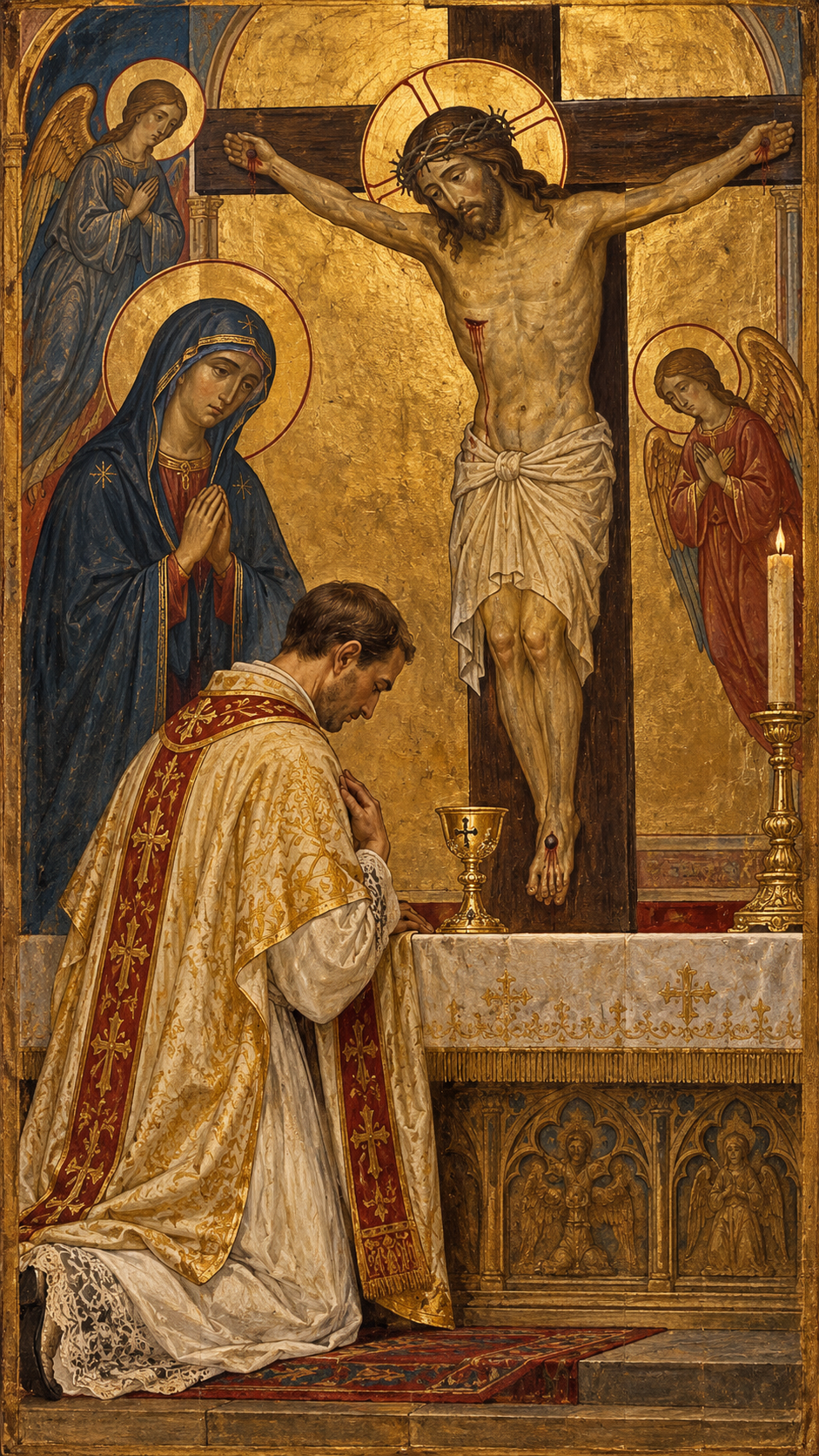
I would now like to discuss a part of the mystery of the Catholic priesthood, and, more concretely, to speak about what goes through the priest’s heart.
If it’s true that what goes through the heart of all men–as Sacred Scripture says–is an abyss, then what passes through the heart of a priest is even more so, and so it’s practically impossible to summarize the vast quantity of feelings, emotions, and acts of a priestly heart.
However, I believe that it can be partially summarized in two points: what goes through a priest’s heart with respect to the infinite, and what goes through a priest’s heart with respect to the finite. In other words, we can speak about what goes through his heart with respect to the Creator, and what goes through with respect to creatures, in a special way with respect to rational ones. Even more simply, we mean what goes through his heart with respect to God and to man. I believe that in this we can see what the Psalmist expressed in a very clear, and yet still mysterious, way: deep calls to deep (Ps 42:8). In our case, it is the depth of a priest’s heart that calls to that other infinite depth, so to speak, that is God’s heart, and also to those other depths which are his brothers’ hearts. Using the words of the Psalmist, we could say that it concerns the cor ad cor loquitur, the heart that speaks to the heart.
A. The Priest’s Heart and God
Without a doubt, God is what is most important in a priest’s heart. However, as God is infinite in His perfection, He is not adequately grasped by the priest’s intellect, his heart, or his will. God is always greater; He is always beyond us. God is always unable to be grasped; as Saint Augustine said, “If you understood Him, He wouldn’t be God,” and as Pseudo-Dionysius also said–in a phrase oft-repeated by the greatest theologians–we know more about what God than about what He is.1 In this way, in our hearts, as in the hearts of theologians, the analogy of faith and the analogy of creature and Creator are always at play. The mystics will explain this as the Dark Night. C. S. Lewis will compare it to reality and to God Himself. In a certain sense, God is an iconoclast, that is, He destroys the images that we make of Him, because He is always greater.
This is why certain ideas grow in the priest and, with the passing of the years of priesthood, they continue to grow more and more: the idea of God’s majesty, for no one is as great as God, the idea of God’s holiness, for whom even the heavens are not clean (15:15) as Job says, the idea of God’s power, which goes through a priest’s heart in a particular way at every Mass at the moment of the transubstantiation, the work of Divine Omnipotence, by which the substance of bread and wine are converted into the Lord’s Body and Blood.
This is why adoration of God spontaneously springs from a priest’s heart: only God is lovable, and nothing else is lovable in comparison with Him. To say lovable is to give Him the greatest, most pure, most unrestricted love with all the powers of the soul, mind, and heart.
This adoration is not some transient thing of the moment, that is, the moment of prayer, the moment of the Mass, the moment of praying the Rosary, or praying the Liturgy of the Hours; rather, it’s something that springs up many times in the day, countless times, because it’s something that stems precisely from God’s greatness. The priest praises God with this adoration, and he praises Him with his lips, but, above all, he praises Him with his whole heart; he praises Him in those moments of full prayer, but, even more, he praises Him who, at every moment, he should be praising with his works, with his life, and with his example. Upon seeing who God is–and that only God is God–the awareness that we are sinners also flows spontaneously and thus, the act of asking pardon from God springs forth from the priestly heart, the act of asking pardon for his own sins and for those of all men, for those of all humanity. When the faithful see the pastor or his vicar in the church praying the Breviary, they see that he is praying for the faithful, he is praying for all of the people who the bishop has commended to him: all the people who are the parishioners of the parish. However, he is praying not only for the parishioners of that parish, but also for all men of all countries in all corners of the globe.
B. The Priest’s Heart and Men
In second place, every man and woman goes through the priest’s heart. Children go through, with their naïveté and their innocence. The youth go through with their enthusiasm and their drive. The older ones go through with their responsibilities, the elderly with their wisdom, the sick with their pains, the poor with their needs, the sinners with their lack of God, and the saints with their fullness of grace. The good and the bad, the just and the unjust, those who are in need and those who have in abundance, all go through.
All go through, without distinction, without exclusion, and for one simple reason: because Christ died for all (2 Cor 5:15). As Christ died for all, the priest is prepared to give his life for all, without exclusions, without exclusivity, even for those who might hate him, because Christ gave him that example when, hanging on the cross, He said: Father, forgive them, they know not what they do (Lk 23:34). Accordingly, as Saint Paul says, the priest laughs with those who laugh, and cries with those who cry.2 Saint Vincent de Paul said, “Je pain, des votres pains”: “I grieve–I suffer–with your pains, with your suffering.” That is the heart of an authentic priest. It is a universal heart that includes and embraces all human beings, and, as it includes and embraces all human beings, it includes and embraces all that is authentically human: social and political problems, economic problems such as lack of jobs, unemployment, the need to defend ones’ rights; the advance of sciences, methods, art, and culture; it includes and embraces everything that is said regarding the family, the country, and the world. In this way, nothing that is authentically human is foreign to him because, as Christ died for all, Christ died in order that man might, with His grace, be able to solve all of the problems that he has.
This, said with my poor words, I reinforce with a magnificent text from that great priest, Saint Luis Orione, the apostle of charity, who was the founder of the Sons of Divine Providence and of the majority of their houses in Argentina, where they give aid to those who are the poorest of the poor, to those who are the most in need.
Don Orione marvelously said: “This is our mission: to see and to love, in the world, only the souls of our brothers, whatever they may be. The souls of little children; the souls of the poor; the souls of sinners; the souls of the just; the souls of those who have gone astray; the souls of penitents; the souls of those who rebel against the will of God, and the Holy Church of Christ; the souls of degenerate sons; the souls of wretched and unfaithful priests, the souls of those undergoing sorrow; the spotless souls white as doves; the souls that have fallen into the dark pit of sensual pleasures and wallow in debauchery; the simple, pure, angelic souls of virgins; souls who glory in evil; souls who lust for power and gold; conceited souls who think only of themselves; lost souls groping to find their way; suffering souls, who are seeking a refuge or a word of consolation; desperate souls, crying out because they feel they are damned; not neglecting souls inebriated with the bliss of the living truth: all are souls beloved of God; Christ died for all and Christ wants to save all, enfolding them in His arms and close to His transfixed Heart. Our lives–continued Don Orione–and the lives of our entire Congregation must be like one colossal hymn sung together–a triumphant paeon of universal brotherhood in Christ! See and feel Christ in Man. Within us must resound the noblest and the deepest music of charity. For us, the focal point of the universe is the Catholic Church; and the saving of souls is the sum and substance of the Christian drama. I hear only the infinite, divine symphony for souls pulsating around the cross, and I am aware that the sacred blood which, on Calvary, was shed for us and the souls of every man has been dripping drop by drop, from the Cross uninterruptedly throughout the centuries. From the Cross, Christ still cries out: I thirst! (Jn 19:28) This is a terrible agonizing cry from parched lips, which is not merely of the flesh, but a thirsting cry for souls; and it is only because of this thirst for all souls that Christ died.”3
From the depths of that great priestly heart of that saint of the Catholic Church, Don Orione asked the following from God: “Set me down, O God, at the gates of Hell so that I may, by Your mercy, close them shut.”4 The priest learns this love by his contact with Christ’s Eucharistic Heart at every Mass.
In a special way, we must always ask the Blessed Virgin Mary that there might be a place for God and for our brothers in the love of the Lord in all priests’ hearts. There has never been a creature on the face of the earth that has loved God as much as the Virgin Mary, and there has never been a creature on the face of the earth that has loved men as much as she.
So, from Her, Mother and Queen of Priests, we ask the grace to always love God and our brothers very much.
Notes
- Pseudo-Dionysius affirms that, speaking of God, “The negations are more true than the affirmations.” In Coel. Hierarchia, ch. 2: PG 3,141 A. Cited by Cornelio Fabro, Drama del hombre y misterio de Dios (Madrid 1977) 170. ↩
- Cfr. 1 Cor 9:22. ↩
- In In Cammino Con Don Orione, (Rome 1972) 328ss. Citing Don Orione, Nel Nome della Divina Providenza, le piú belle pagine (Rome 1995) 134-135. English translation from On the Way with Don Orione, (East Boston, MA, 1974) 255-6. ↩
- In In Cammino Con Don Orione, (Rome 1972) 328ss. Citing Don Orione, Nel Nome della Divina Providenza, le piú belle pagine (Rome 1995) 136. English translation from On the Way with Don Orione, (East Boston, MA, 1974) 256. ↩
Source: Carlos Buela, You Are Priests Forever, Volume 2: What the Priest Is (Part Two), IVE Press, New York, 2013, pp. 57-62. Text and notes from the original edition.